
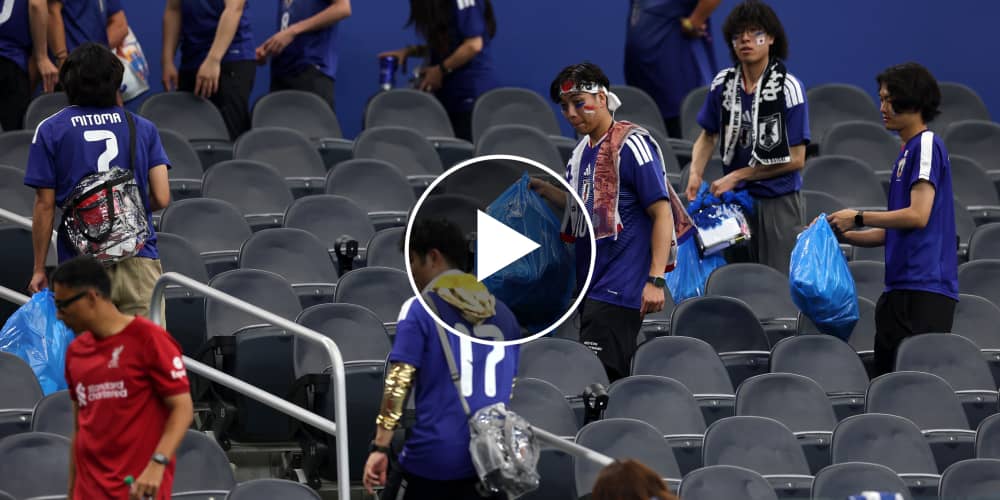
Japan supporters once again impressed at the World Cup by leaving the stands spotless following their opening match against the Netherlands in Texas on Sunday, explaining that it is “Japanese culture” to clean up after themselves.
After the entertaining 2-2 draw, many fans remained inside the stadium to ensure the venue was left exactly as they found it. They carefully collected discarded rubbish and packed it into blue plastic bags.
- Watch: New footage shows Van Dijk’s goal shouldn’t have stood for push on Japan star
- New footage shows terrifying tornado besieging England players at World Cup
The practice is something many Japanese people learn from a young age. Supporter Eita Tanaka told AFP that “we have to think about everyone”.
“Japanese people think that when we use a certain place, we were told that you have to make that place look tidier when you leave than it was when you arrived,” explained the 20-year-old, who was holding a beer and several cups while dressed in Japan’s blue jersey.
The reason Japan fans clean the stadium after each game. Respect. 🤝🇯🇵 pic.twitter.com/o9qJUOLefY
— FIFA (@FIFAcom) June 15, 2026
“For example, at school in our classrooms we tidy it up after ourselves without our teacher telling us.”
Japan are competing in their eighth consecutive World Cup, and the cleanliness of their supporters has become one of the country’s most recognised traits on the global stage.
- Watch: Andy Robertson goes viral for genius hack to beat new World Cup throw-in rule
- Watch: Fan sneaks tequila into World Cup stadium in a flask disguised as a phone
Even NFL star Jameis Winston was spotted taking part in the post-match clean-up, sporting a blue Japan shirt bearing his name.
Another supporter, Futo Hagiwara, said he was delighted that people around the world had recognised the actions of Japanese fans positively.
“This is our culture, that means everywhere we go we need to clean it after ourselves, it’s our spiritual way, our attitude,” he said.
Sociologist and philosopher Masachi Ohsawa believes the behaviour is driven by a combination of personal responsibility and social expectations.
“While Japanese people tend not to take much interest in justice on a large scale – issues like global inequality, conflict or climate change – they are extremely sensitive to moral considerations on a smaller scale,” he explained.
“When it comes to people who they share the same space with or have direct personal contact with, they feel a strong desire not to cause them any trouble or make them feel uncomfortable.”
SCHOOL OF LIFE
Cleaning duties form a key part of Japanese education, with schoolchildren routinely helping to maintain classrooms, hallways and other facilities.
Public rubbish bins are relatively uncommon across Japan, and residents are generally expected to carry their waste home.
Disposing of household waste can often be a complicated process requiring rubbish to be sorted into numerous categories.
Scott North, an emeritus sociology professor at the University of Osaka, said he and his neighbours regularly participate in community clean-up activities twice a year, removing weeds and gathering garden waste.
According to North, these community groups typically have organised structures with leaders and followers, similar to the way Japanese football supporters operate.
“Since everyone comes together, there’s an expectation that they’ll act as a group,” said North, an American who has spent around four decades living in Japan.
“And when the leaders break out the bags and say here you go, nobody is going to say no.”
Ohsawa suggested that the phenomenon can also be understood through the Japanese concept of “reading the air”.
“In Japan, even if one person starts picking up litter, those around them feel they simply cannot help but join in,” he said.
“That’s because if they don’t, the people they are with will think they are a bad person.”
He added that peer pressure remains a significant influence within Japanese society.
“In this case, the primary motivation isn’t so much a desire to keep the stadium clean or to avoid causing trouble for the people who have to clean the stadium afterwards,” he said. “It’s more a desire not to be seen as a nuisance in one’s own group.”
Regardless of the motivation, Japan’s supporters are expected to continue the tradition throughout their time in the tournament.
Their next fixture comes against Tunisia in Mexico on Saturday, and Hagiwara is eager to continue setting an example.
“We usually don’t tell children they should do it,” he said.
“We just show our actions and behaviour, and other people follow.”