Switzerland’s 1-1 draw against Qatar at the World Cup sparked controversy after their opening goal came from a penalty decision that left many supporters questioning a possible offside in the build-up.
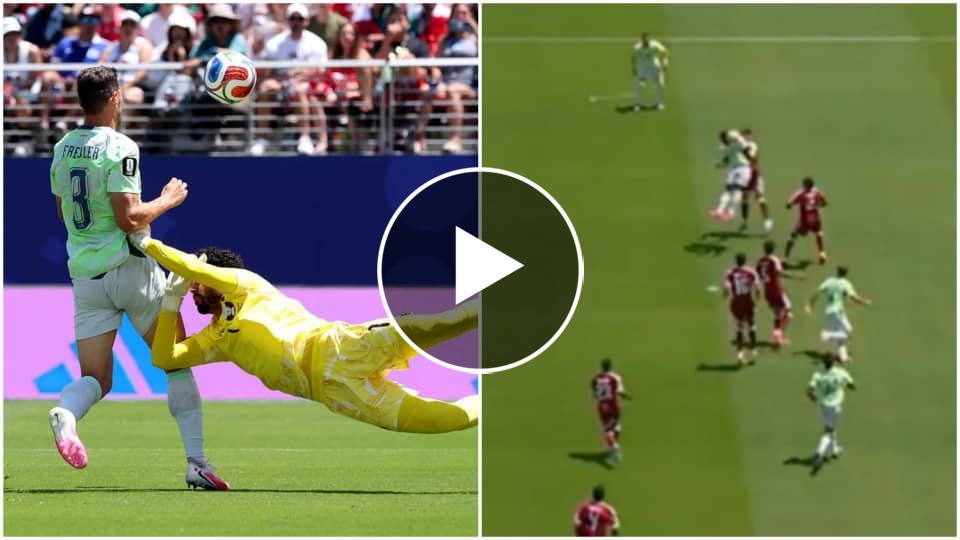
On the tournament’s third day, the Swiss were awarded a spot-kick after Remo Freuler was brought down inside the penalty area by Qatar goalkeeper Mahmoud Abunada.
Referee Hector Said Martinez Sorto of Honduras had little hesitation in pointing to the spot after the collision between the two players.
- Watch: Fan sneaks tequila into World Cup stadium in a flask disguised as a phone
- Watch: Cristiano Ronaldo’s shocking misses in Portugal’s win over Nigeria
- Watch: Donald Trump brutally ignored by USA captain Tim Ream in awkward phone call to Pochettino
However, replays suggested that Freuler, who featured 33 times for Nottingham Forest during the 2022/23 campaign while on Bologna’s books, may have been marginally beyond the last defender before the foul occurred.
The incident was reviewed by VAR, including a check for offside, and the penalty was ultimately allowed to stand while Abunada received medical attention. No supporting images were shown to viewers during the broadcast.
Can someone pls explain to me why the penalty was given, when Freuler was clearly in an offside position pic.twitter.com/dhFC82vneB https://t.co/AGHwwZRvfh
— Ezzy (@EzzyMUFC) June 13, 2026
Breel Embolo once again delivered on the international stage, converting the penalty from 12 yards to register his 25th goal for Switzerland.
Debate over the decision continued into the break, with former Manchester United defender Gary Neville expressing frustration over the lack of visual evidence.
Neville argued that given how close the call appeared, especially with many believing Freuler had strayed offside, the officials should have released proof of the review.
During the Qatar vs. Switzerland match in the San Francisco Bay Area, a brief technical outage prevented the onside animation graphic from being generated ahead of the penalty awarded to Switzerland in the 14th minute. The issue was quickly resolved.
The workflow of the VAR was… pic.twitter.com/ONpWxXDPE6
— FIFA Media (@fifamedia) June 13, 2026
Although semi-automated VAR technology was being used, no graphic or animation was displayed before the half-time whistle.
Speaking in the ITV Sport studio, Neville said: “FIFA are the host broadcaster, they’ve got the evidence of the automatic decision which they can show us.
“Why are they not showing us?
“They did this in the last tournament, fans are already distrusting of FIFA and technology to start with.
“There is a massive question mark over that, because that is offside in my eyes, until they prove me different.”
Former Everton striker Duncan Ferguson shared similar concerns, stating: “I think it’s tight. I’d like to see it from the other side of the pitch but, yeah, it does look offside. I agree with you.”
Ian Wright, meanwhile, fresh from an emotional meeting with his son Bradley Wright-Phillips, also questioned the lack of evidence, saying: “With the semi-automatic lines, why haven’t we seen that? “He looks offside. I just can’t understand it.”
Several hours after the final whistle, FIFA published VAR images through their @fifamedia account on X.
The images displayed the offside lines used during the review and confirmed that Freuler had been judged onside. FIFA also issued an explanation regarding the missing graphic.
It read: “During the Qatar vs. Switzerland match in the San Francisco Bay Area, a brief technical outage prevented the onside animation graphic from being generated ahead of the penalty awarded to Switzerland in the 14th minute. The issue was quickly resolved.
“The workflow of the VAR was not affected by this issue and followed the normal procedure in checking the on-field decision. The lines used by the VAR to check the position of the relevant players did not show the attacking player to be in an offside position in either of the two situations immediately before the penalty decision.”
Despite taking the lead and creating numerous opportunities, Switzerland failed to secure all three points.
Statistics from OPTA showed that Murat Yakin’s men recorded 26 attempts on goal, seven of which tested the goalkeeper, while generating an expected goals (xG) figure of 3.6.
Yet the scoreline is what counts most, and Qatar made the Swiss pay for their missed chances with a dramatic late leveller.
The equaliser was officially recorded as a Miro Muheim own goal after the defender inadvertently headed the ball into his own net while under pressure from Boualem Khoukhi.