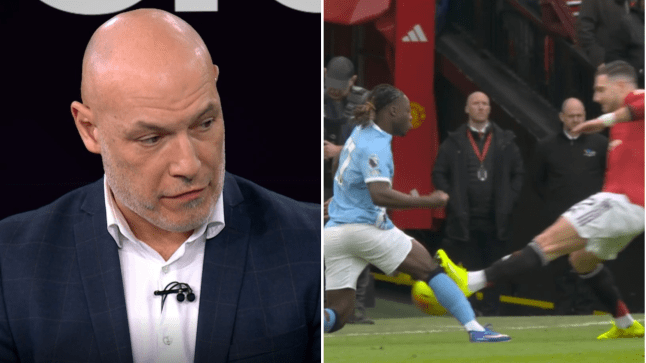
PGMOL chief Howard Webb has backed Anthony Taylor’s choice not to dismiss Diogo Dalot during the Manchester derby, explaining that the challenge fell ‘in the grey zone’ and was not automatically deserving of a red card.
Controversy arose early in Saturday’s heated clash at Old Trafford when United full-back Dalot caught the top of Jeremy Doku’s knee with his studs near the left touchline.
- Ruben Amorim ‘squared up to Lisandro Martinez’ in furious training ground fight
- Enzo Maresca finally breaks silence on Chelsea exit as club appoint Liam Rosenior
- 💙 Click here to join the Chelsea WhatsApp group 💙
Doku appeared to be in visible discomfort as he tumbled to the turf at the Theatre of Dreams.
However, referee Taylor ruled that the incident merited only a booking, a judgement that was later upheld by VAR official Craig Pawson.
Manchester United went on to claim a surprise 2-0 win over their fierce rivals in Michael Carrick’s first match back as interim boss, with Bryan Mbeumo and Patrick Dorgu striking during a rapid 11-minute spell after the break.
A number of City fans reacted angrily after reviewing slow-motion footage of Dalot’s 10th-minute challenge on Doku, pointing to the studs-up nature of the tackle.
Pep Guardiola, however, chose not to pin the defeat on the decision, despite watching his team fall further behind runaway Premier League leaders Arsenal.
Anthony Taylor’s conversation with VAR Craig Pawson
AT: ‘I’m going yellow card here, it’s a glance.’
CP: ‘Yeah, he does. There’s glancing contact on the knee. There’s no force but there’s glancing contact.
‘He’s tried to play the ball and he catches him with glancing contact. Can you see it? Can you see?
‘Glancing contact, there’s no force, he’s tried to play the ball. He flicks, he misses the ball, he catches him with the follow-through.
‘Yeah, I’m happy to confirm the on-field decision. Tayls [Taylor], confirming the yellow card for Manchester United number two.
‘He tries to play the ball, he misses it and then he makes glancing contact onto the knee. There’s no force or intensity but he does catch him with the follow-through.’
AT: ‘Yes, I know. That’s why it’s only a yellow because it’s glanced contact.’
Responding to Mike Dean’s view that the tackle was ‘100 per cent’ a sending-off, Guardiola said: ‘You could say that, you could say that red card, different game. Many, many situations happen.
‘It is easy for me to come here and say it should be a red card. It is not about that; we will not grow up if that is the argument to win or lose a game. You have to do better, and we didn’t today.
‘We have to look at ourselves. There are some teams that won 10 versus 11. Maybe we wouldn’t have won.’
Speaking about the decisive moment on the Premier League Match Officials Mic’d Up programme alongside Michael Owen, Webb explained: ‘It did split opinion but I’ve also heard a lot of opinion that this should have been a red-card offence.
‘The officials on the field saw the action of Dalot, the saw him stretch forward with his foot. He touches the ball and then there’s contact on Doku.
‘They deemed that to be a reckless action and therefore worthy of a yellow card.’
Webb added: ‘You’ll see on the field that there’s not a lot of reaction to it when it happens in full speed.
‘The VAR’s job then is to decide if the on-field decision of yellow clearly or obviously wrong.
‘Now, we talk on this show about a lot of situations that sit in the grey zone, where there’s a mix of considerations. I think this is one of those. I know other people think it’s clearly red but I don’t agree, I think there’s a mix of considerations.’
Webb also suggested that slow-motion footage can give supporters a ‘distorted view’ of incidents like Dalot’s challenge, stressing that ‘the full mix of considerations’ must be assessed.
‘When we look at this, we see that the point of contact is on the knee, but we also have to factor in speed, force and intensity,’ said Webb, who took charge of the 2010 World Cup final.
‘You’ll not see many red cards in the Premier League for serious foul play that don’t involve those things.
‘We evaluate those things through a full-speed view or the incident and without looking at it like that then you get a distorted view, you don’t get a true picture of how much force and speed there was in the challenge.
‘Then we have to slow it down, of course, to see the point of contact so different ways of looking at the video for different considerations, but we have to consider the full mix of them when deciding a final outcome.’